Showing posts with label penguins. Show all posts

Sunday, 1 March 2020

February 4: The Final Day of Excursions and Saying Goodbye to Antarctica

Thanks for coming to
see me, even though you
weren't feeling well!
Written on March 1

It's Not Coronavirus, But Still
And then I got sick. Boourns!

I had been fighting a sore throat for a couple of days before taking the Polar Plunge; the sore throat escalated after I'd jumped into the cold waters of the Southern Ocean, and I woke up on February 4 with a terrible head cold. Given the coronavirus fears, I checked in with the ship's doctor who gave me throat lozenges, asked me to report in again if things got worse, and sent me on my way.

This was the last day of excursions on our voyage, but with me feeling so poorly, I just didn't have the energy to keep up the same pace as previous excursion days. Hubs, at this point, was also feeling a little "zodiac-ed out" so we had a bit of a modified/easier day of outings.

Morning Excursion: Cuverville Island
Cuverville Island is a small rocky island in the Errera Channel and home to the largest gentoo penguin colony in the region. Even though I wasn't feeling well, I was definitely not about to give up this last chance to see more penguins on our trip. After a chat with the Expedition Leader, we were able to skip the zodiac cruising portion of this excursion, and opt only for the shore landing.

As this was our final excursion, we did our best to just be in the moment after landing on the island - sitting down, listening to all of the penguin sounds, watching adult penguins be with their chicks, and seeing the penguins splashing around and porpoising in the shallow water along the beach.

Beach at Cuverville Island

Parenting, am I right?

Gentoo penguin and whale bones

Heading back to shore

Parent-teacher meeting?

Just hangin'

Practicing for National Geographic © Matthew Boulton

Afternoon Excursion: Paradise Harbour 
The original plan for the afternoon was to head onshore midway along the west coast of the Antarctic Peninsula at Paradise Harbour, to visit Argentine Base Brown. Formerly known as Almirante Brown, this place has a bit of an incendiary history. From our voyage journal provided by Quark Expeditions:
"Almirante Brown was the base conducting Argentina’s Antarctic marine biology and hydrography research. In 1984, the base doctor, who did not want to overwinter a second time, burned down the main base building. The concrete foundations still exist behind the remaining buildings. 
The base was reopened in the 1990s but plans to rebuild it were dropped during Argentina’s 2001 economic crisis. Currently, the former boatshed is used as summer accommodation for the scientific staff and the cleanup team. The current scientific program is continuing the hydrographic work of the 1990s, and studying the effects of these physical factors on biological systems in the harbour." 
(Aside: one of the historians on our ship, who also happens to be Argentinian, joked that if someone from Argentina says they're going to burn something down, you should take them seriously.)

Argentine Base Brown, taken from Ocean Endeavour
© Matthew Boulton
However, given the nice weather on this day, the staff at Base Brown decided to do some maintenance and re-painting of the buildings, which meant no shore landing for us. The plan was revised for everyone to instead take in an extended cruise around Paradise Harbour and nearby Skontorp Cove.

As beautiful as this spot was in the brilliant sunshine, and even though it was the very last excursion of our voyage, hubs and I opted to skip the zodiac cruise and enjoy the amazing views from the ship instead. While part of me is a little disappointed that we missed this outing, it was quite nice to have the ship nearly to ourselves. Plus, given my nasty cold, I think staying onboard was the more sensible choice versus being on the water in the zodiac for more than an hour.

Farewell Antarctica!
Everyone came back to the ship in the late afternoon, and our Expedition Leader led everyone in a farewell toast to Antarctica - a touching albeit bittersweet way to say goodbye to the 7th continent before heading northbound on the Drake Passage and back to South America the next day.

Final note on this day: we heard that a few members of the expedition team hosted an epic Antarctica-themed quiz night that evening, but we went to bed early.

Our Expedition Leader Laurie leading the farewell toast

Cheers to you, Antarctica!
© Matthew Boulton

Paradise Harbour: a stunning way to end our time in this amazing place

Monday, 17 February 2020

February 2: It's Like Being on a Different Planet, but with Access to the Superbowl

From February 2, 2020 (Part 1 written on this date)

Part 1
Ahh, finally. A chance to sleep in. Except I didn’t at all, and woke up at 6:00 AM even though breakfast wasn’t ready until 8:00 AM. Gah.

While being terribly excited to experience everything we can, I also blame these early mornings partially on all of the programming available to us. With all of the presentations and lectures and landings and more, our days have been jam packed. I brought my runners and there’s a gym, but I haven’t spent any time in there at all because, well, there is no time! In some ways, I kind of wish “down time” would be built in - even a half hour or 60 minutes here and there would do - just so we have the opportunity to decompress and get ready for the next inevitable exciting and/or interesting and/or educational thing (I’m really not complaining; just a little tired).

And from this point on, I stopped writing on the ship (written on February 17)
I’m not entirely sure why, but I think I was feeling overwhelmed by all that we were doing every single day; I even skipped a presentation on “Why Antarctica Matters” on this day while the ship was navigating to our next destination. Shocking! (Thank goodness hubs went and was able to fill me in afterwards, ha.)

I had been attempting to do my write-ups in the mornings while the experiences from the previous day were still fresh in my mind, but by this point - as somewhat evidenced by what I wrote on February 2 - trying to document it all as it was happening almost started to feel like a chore. Of course in hindsight, I wish I’d forced myself to do it because now I’m left trying to piece it all together from our Daily Programs and the pictures I’d captured that day. Oh well.

Okay, so here we go: me trying to remember what happened!

What a palaver!
Early Afternoon Excursion: Palaver Point
Our first excursion for this day took place in the early afternoon at Palaver Point, west of Two Hummock Island of the Palmer Archipelago. About the site, from our Daily Program: “Home to a small Chinstrap penguin population, its name describes the kerfuffle and commotion of the colony.” And the name did not disappoint! There was a lot of squawking and blaring going on. Even though we’d already seen Chinstraps on our voyage, this was the first time seeing an actual Chinstrap colony. It was also the first time on the trip that we stepped foot on snow - which was surprising for many guests on the boat, who were expecting a lot more of the white stuff, being Antarctica, and all (but it’s summer!).

Decent view from the point

Looks like this Antarctic fur seal was making a palaver, too

Penguin tracks in the snow

It was from the zodiacs at Palaver Point where we also saw our first Minke whale! As part of the excursion, those who are seeking certain “adventure options” can pay extra and do such activities as kayaking, paddling, or stand-up paddle boarding. As we were getting into the zodiacs from the ship, there was a Minke whale playing with the stand-up paddle boarders who were getting set for their paddle around the point. He seemed like a friendly and curious little whale, hanging around to see what was going on and engaging with the paddlers.

First Minke sighting

Italian Market Dinner and a Note About the Dining Room
We enjoyed an early dinner, which was Italian-themed. The food and beverage, and kitchen and serving staff, were all incredible on our journey. Friendly and accommodating, after the very first day when hubs and I talked to Keith the Maître d' and Marlon his second-in-command about our dietary restrictions, we were greeted as “Ma’am Angie” and “Sir Matthew” (nicknames, I should say, we’ve missed hearing every day since we left the ship). The head chef is also a wizard with watermelon carvings and had intricately carved fruit waiting for all the guests as we walked into the dining room that evening.

Watermelon flowers

What's "hoot hoot" in Italian, I wonder...?

Evening Excursion: Graham Passage
The original plan for this evening was to be in Cierva Cove. I cannot remember why, but that plan had to change. And so, that evening after dinner, we loaded up the zodiacs again to cruise instead around Graham Passage which “lies north of Charlotte Bay between the Antarctic Continent and Bluff Island. Stunning, narrow and glaciated, this passage also provides great potential for sighting marine mammals.”

And how! It was here that I first felt like we were on an entirely different planet. The evening was a little gloomy. It had been misty and then started to rain, which turned into snow. At one point during the zodiac cruise, we were surrounded by huge, towering walls of ice. We watched seals and birds resting on icebergs. It was so quiet.

So many terms to describe the different kinds of ice...
think this is an ice wall

Antarctic cormorant a.k.a. shag

Giant ice! Ship in the distance for scale

And then, as if by magic, the snow stopped and a Minke whale appeared - and it wasn’t just any sighting. This guy was another curious whale, swimming in between and next to the zodiacs, and then underneath us! He even followed us back to the ship when it was time for us to go in for the night. It was an incredible encounter that left us wanting more. I’m not sure what we missed at Cierva Cove, but Graham Passage was an amazing alternative and a definite highlight for me.

Note: the next morning talking to Jimmy the whale guy, I asked him if there was any risk to the whales being so close to the propellers on the zodiacs. He had absolute confidence that the whales know what they are doing, and as long as we are being predictable i.e. driving straight and not making sudden movements, there is zero chance of them being hurt. In his words, “They are Olympians.”

It's a Minke over there!

Having fun with the humans

Swimming under our zodiac

Thanks for stopping by, Mr. Minke!

The Superbowl
Amazingly, the excitement for the day wasn’t over yet! The crew made last-minute, surprise arrangements to try and live stream the Superbowl game for the guests. Watching the Superbowl from a ship in Antarctica... so weird! But, pretty cool. It worked out well, although they had to use almost every bit of bandwidth available on the ship for the game. (Hubs and I only made it to halftime and then went to bed.)

Speaking of internet, we could have paid a (not inexpensive) fee to access WiFi for the time we were on the ship, but we opted not to. There were many reasons for this: as mentioned, it was costly. But the internet was also dependent on satellites and could therefore be either intermittent or non-existent. And how many times in our over-connected lives would we have a real chance to just disconnect from it all? We reasoned that, if there was an emergency, we wouldn’t be able to do anything about it anyway. So we took the opportunity and decided to truly be offline.

...except, obviously, when the ship streams the Superbowl live for everyone, ha. The crew threw a party, complete with bar food and snacks, and a Superbowl-themed sheet cake! There were even 49ers and Chiefs decorations too, which the ship’s receptionist apparently spent most of the day printing and cutting out. Of all the things we had experienced on the trip so far, this was one of the more surreal ones, for sure.

Sunday, 16 February 2020

February 1: Is This the Real Life?

Tabular iceberg
From February 1, 2020 (written on this date)

We woke up to tabular icebergs outside our window. And as I write this, I am enjoying a cup of tea while watching penguins swimming in the Antarctic Sound. As Queen so aptly put it: "Is this the real life? Is this just fantasy?" Somebody pinch me.

Morning Excursion: Brown Bluff
It was a very early start for all guests today, with breakfast starting at 6:45 AM in order to get everyone outside by 8:00 AM or so. The original plan for this morning was to do a shore landing onto Brown Bluff; however, floating ice [or "growlers"] along the coastline meant this would not be possible. What to do? We shifted slightly and experienced our first zodiac cruise of the trip, instead!

We were out there for about an hour and a half, drifting amongst icebergs, Adélie penguins… and humpback whales! It’s amazing to be out there, where it’s so quiet, and then suddenly to hear a BLOW in the distance. Based on the whale spotting done by all of us in our zodiac, we saw at least three different humpbacks in the space of 90 minutes. Crazy.

Captured some great photos and video on this excursion, including Adélies giving themselves a bath, panoramas of the iceburgs and bluff, and tail flukes of two of the humpbacks.

One of our first "humpie" sightings

Adélie bath time!

A Note About Clothing
I’ve very quickly learned that it’s best to overdress. On the shore landings we did yesterday, especially when walking around and navigating over rocky terrain, I was definitely too warm. But as soon as we got going on the zodiac, I was the right temperature. For today, since we were just on the zodiacs and not on land at all, I dressed as I did yesterday and was slightly cold, but only towards the end of the trip.

When I was getting ready for this trip, I was worried about over packing - but I’m definitely over that, now.

Speaking of which, I learned yesterday that a checked bag belonging to an older gentleman on this ship did not arrive at all, so he was forced to restock all of his warm clothing from the shop on the boat, which has a very limited selection. Unlike when travelling to a city, for example, it’s not like the airline can get his bag to him while we’re in the middle of the Antarctic Sound, right? Can’t help but feel so bad for him.

Note: this is why I always prefer to carry on, whenever possible. Even for our charter flight from Buenos Aires to Ushuaia, I made sure to pack at least one warm outfit for the excursions, just in case my checked bag went missing. Some folks may think this is overkill, but I don’t see anything wrong with having a little bit of paranoia and/or lack of trust in baggage handlers. Case in point.

Afternoon Excursion: Paulet Island
This was a dual excursion, with half the guests zodiac cruising and the other half landing at Paulet Island, and then both switching after a period of time to do the other.

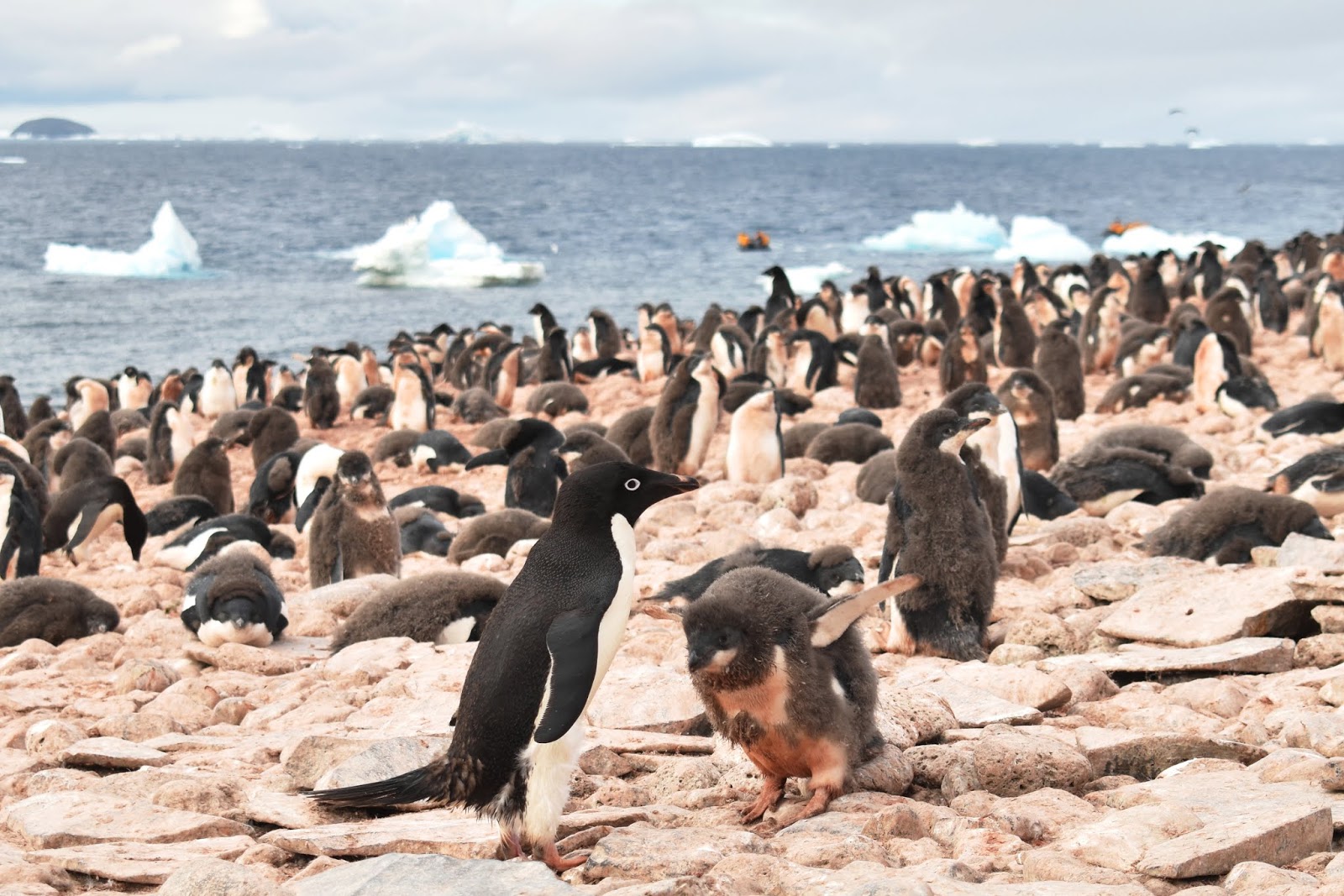
Saw Weddell Seals, and one of the biggest Adélie penguin colonies in Antarctica - approximately 400,000 adults and chicks all in one place! Chicks were chasing their parents for food, parents were trying to run away from their pestering chicks, and all the while it smelled so bad (ha ha) and it was amazing to be walking amongst all the penguins, and seeing them hanging out on icebergs.

Think we interrupted this guy's afternoon nap

So many Adélies!

The only concern was that the penguins seemed pretty comfortable amongst all the humans. At the bar talk later in the evening, a researcher from Dartmouth College in the United States talked about his time researching at McMurdo Station, mentioning that the Adélies there - a place much less visited by humans - were very skittish around people. Makes one wonder if surges in tourism have habituated these penguins to humans, and whether that should be okay.

Speaking of this, there are researchers on the boat from Monash University in Australia who are working on developing a sustainability and long-time conservation plan for tourism in Antarctica.

Adélie penguins and chicks as far as the eye can see...
and nose can smell

Every day is a bad hair day when you're moulting

Ocean Endeavour from Paulet Island

Random Tourism Facts
There have been so many presentations and things to learn on excursions and from the guides, that it’s been very hard to keep track of it all! Here are some random other facts specifically about tourism that we’ve picked up along the way.
  • Antarctic tourism operators are all part of a group called IAATO, to ensure sustainability of the region amidst increasing accessibility and interest in visitors to Antarctica.
  • Landing sites are restricted to two ships visiting per day. For example, if other ships had already “booked” a landing on Paulet Island yesterday before us, we would not have been able to - which would have been a real shame, but understandable, given efforts to minimize human interaction with the wildlife and the environment, in general.

Penguin traffic, Paulet Island

Saturday, 15 February 2020

January 31: First Iceberg, Penguin (!) and Land Sightings

From January 31, 2020 (written on this date)

First iceberg!
First things first. I did not win the iceberg spotting challenge from yesterday.

About Antarctic Cetaceans 
But that was only because we attended an amazing and thoroughly entertaining talk about Antarctic whales and dolphins, given by the designated marine biologist on the trip (i.e. there are other marine biologists travelling with us as crew, but he’s the one doing the talks). Why so fascinating? To explain just how big the blue whale is, the largest of all the marine mammals, he walked from the lounge where all the presentations, talks and briefings are held, out the door onto the deck of the ship and right to the edge - and it still wasn’t long enough to show 33 meters in length. So… HUGE, essentially.

We may see a blue whale, although it’s more likely that we’ll see humpbacks. We were also reminded that orcas are not whales but rather, dolphins. Although, they are quite treacherous - they’ll eat anything, including sharks. But are also very picky eaters and tend to feed off one specific type of animal. This is why our resident orcas off the coast of British Columbia are dying out; they are used to eating only chinook salmon and we’ve overfished this specific salmon stock. Want to save our orcas? Stop fishing all of the chinook and encourage our government to place stricter regulations on this practice.

Approaching the South Shetlands

First Penguin Sightings
We spent a lot of time outside on the deck, on the lookout for wildlife. There’s so much to see, even just from the ship: we spotted Wandering Albatross, Northern Royal Albatross, Northern and Southern Giant Petrels (who, we were told by one of the guides, are basically vultures - absolute opportunistic predatory birds), Antarctic fur seals… and penguins!! Hard to tell which specific species they were from the ship, but there were tons of them swimming along and flying through the water. I may have a cried a little, and I’m not ashamed to admit it.

Flying penguins - built for water!
Watching these penguins in the vast open water is incredible, and makes me feel so sad for captive penguins - and all animals, really - in places like zoos and aquariums. No animal belongs in that environment and I’m convinced of that now more than ever.

Land Ho!
We spotted land at about noon, after the marine biologist’s talk.

(Aside: the marine biologist’s name is Jimmy and he is originally from Saskatchewan! So basically, he’s living my dream; when I was a kid, I wanted to be a marine biologist but talked myself out of it because… Saskatchewan. But - he’s doing it! And he’s amazing. This is his 12th season with Quark Expeditions.)

We did our first shore landings: Fort Point and Hardy Cove, which are both on the south side of the Greenwich Islands. To get to these places, the ship anchors off a ways-away, and everyone hops into zodiacs.

Feeding time for this Gentoo penguin chick
Fort Point
At Fort Point, there were hundreds of penguins! Chinstraps and Gentoos, with their chicks - in every direction. I watched parents feed their young, penguins returning to land from the water, penguins waddling down into the water from the land, penguins watching all of us humans watching them. There were a few Antarctic fur seals at this landing as well, napping and “honking.”

At one point, I was lying down on my stomach to try and get some interesting shots and a tern walked right in front of me - and kind of gave me a little side-eye, if I’m not mistaken. Sure enough, a few minutes later I feel a “tap tap tap” on the bottom of one of my boots - and it’s the same tern! Totally reminded me of the buns at home when I’m lying on the floor and they nudge me to move out of the way. Totally made me laugh.

My snowy sheathbill friend
Hardy Cove
At our second landing we saw an incredible ice glacier, along with a terminal moraine (hubs pulled his rarely-used geology background out to explain to me what this is), more Antarctic fur seals taking an afternoon nap, and a couple of Gentoos just hanging out.

If every day is going to be like this, I never want to come home.


"Ugh, humans."

Terminal moraine © Matthew Boulton

Zodiac cruising at Fort Point


Thursday, 16 January 2020

Penguin Wallpapers (Alternate Title: I am a Crazy Penguin Lady)

Many years ago, a design-minded friend got me interested in changing my desktop calendars and wallpapers each month.

There are many designers who create wallpapers, but instead of seeking out individual designs, I tend to pick and choose from those compiled each month by Smashing Magazine.

Why do I mention this? Because I purposely downloaded a number of penguin-related wallpapers to get me through January until we leave - which, by the way, is in 9 days! Thought some of you might want to download for your own enjoyment and viewing pleasure. Here are some of my current favourites - so cute, right??

© Melissa Bogemans

© Veronica Valenzuela

© Veronica Valenzuela

Sunday, 5 January 2020

The Route

There are apparently a few ways one can get to Antarctica. In a nutshell, this is our route:
  1. Fly to Buenos Aires, Argentina.
  2. Get on charter flight in Buenos Aires organized by the expedition company and fly to Ushuaia, Argentina.
  3. Get on boat.
  4. Cross Drake Passage.
  5. Arrive in Antarctica!

Antarctica on Social Media

If you're interested, I would highly recommend following the Quark Expeditions account on Facebook. They post really cool stuff about their destinations - in particular, the polar regions. 

For the penguin fans, Penguin Watch is also an awesome citizen science account run by scientists and "penguinologists" (no joke). 

Between these two accounts, I've become more familiar with the route and Ushuaia, and have (hopefully!) learned a little bit about what to expect when we get to the Antarctic Peninsula. 

© Quark Expeditions, Arctic & Antarctic Expeditions 2018.19

Sunday, 29 December 2019

Even More About Antarctic Penguins!

© Peppermint Narwhal Creative
In my last post, I began describing "The Eight Great Penguin Species of Antarctica" and introduced the first four on the article's list. Here are the other four species of penguin that live in the Antarctic region, starting with #5.

By the way, if ever you see a commercial or TV program that shows a polar bear together with a penguin, know that this is factually inaccurate! Polar bears are from the Arctic north, whereas penguins live only in the southern hemisphere. Now you know... if you didn't already.

5. Macaronis
These island-dwelling crested penguins are the ones with the distinctive yellow and gold tufts of feathers atop their heads. In the process of sharing incubating duties, adult macaronis lose up to half their body weight! Talk about energy expense.

6. Rockhoppers
There are three distinct species of rockhopper penguins, based on reproductive behavior and breeding location: northern, southern, and eastern. Rockhoppers are one of the smallest penguin species, and get their name from their preferred habitat of rocky, windswept shorelines on the islands north of Antarctica. On Antarctic voyages, mostly northern and southern rockhopper penguins are spotted.

7. Magellanics
These penguins are named after the famous explorer Ferdinand Magellan, and are closely related to Galápagos penguins, Humboldt penguins, and African penguins. They tend to be shy around humans (aww), and if it gets too hot, they will shed beak feathers, pant, and stretch their flippers to catch a breeze. Magellanic penguins are comparably long-living, reaching around 25 years in the wild.

8. Kings
King penguins are so much fun! They are the second-largest penguin species after emperors, and the most marine of all penguins - and indeed all birds, spending more time at sea than any other. King penguins can dive to depths of more than 300 meters to pursue prey, staying underwater for up to nine minutes... amazing! They are highly social birds that gather in massive colonies. King penguins are known by scientists to have mid-afternoon naps, sleeping more deeply after lunch than during the morning (I can soooo relate).

There ya have it: a summary of the eight penguin species of Antarctica. I'm hoping hubs and I can check off seeing at least four on our trip. We'll just have to see what happens!

© Peppermint Narwhal Creative

Saturday, 28 December 2019

Penguins are my Favourite

Those who have known me a long time will know that I have loved penguins for, well... forever!

I turned 40 years old this year and, to celebrate, hubs and I decided on this trip to Antarctica to see penguins in the wild. (Yes, I realize wild penguins also live elsewhere but, c'mon - these are official Antarctic penguins).

Ever since I started researching this trip, I have had a website open on my phone called, "The Eight Great Penguin Species of Antarctica." Here are highlights from the article on four of those types of penguins.

1. Emperors
Emperor penguins are the largest - and I'd wager, probably the most recognizable of all the Antarctic penguins, thanks to Morgan Freeman and March of the Penguins. They form large colonies on the sea ice and are found mainly in the Ross Sea and Weddell regions, especially Snow Hill Island. Based on where we are headed, this sadly means we won't get to see any Emperors on our trip. Boourns. (Hey, Antarctica is a BIG place. What can ya do?)

2. Adélies
The most widely distributed penguin species in the world, Adélies are found on the northerly Antarctic pack ice during the winter and in the summer return to the continental coastline and Antarctic islands. These are small and fiesty, no-holds-barred penguins who aren't afraid to pick fights (see video below). Hoping to see a lot of these guys on our trip.


3. Gentoos
As adults, gentoos are the third largest penguin behind emperors and kings. They build nests on beaches and in grass tussocks and are highly aggressive in defending their turf. Gentoo penguins live about 15-20 years and are one of the fastest-swimming birds, reaching speeds up to 36 kph (22 mph). So speedy!

4. Chinstraps
Why are they called "chinstraps"? Just look at their facial markings! With roughly seven million pairs of chinstrap penguins in the world, these penguins are one of the most abundant. They are also an aggressive species, often getting into fights with other penguins. (Hm, sensing a theme. Maybe all penguins are jerks?)

Want to know about the other four Antarctic species of penguins? I'll post about them next time.