Knowing about our upcoming trip, a work colleague shared
this article with me (text copied below). Working in project and change management, she felt some of the lessons have great applicability to our work - namely, planning, preparation, and setting specific goals.
Hubs and I won't be anywhere near the South Pole on our trip, nor are we setting out to discover previously unchartered territory, so I feel like there aren't a lot of lessons from this article that we must necessarily heed for our own "expedition". But I'm still sharing as I found it to be fascinating history from this part of the world.
Warning: it's a long read. But again - fascinating!
What the Race to the South Pole Can Teach You About How to Achieve Your Goals
Brett & Kate McKay
April 22, 2012 (Last updated: May 28, 2018)
In 1910, two explorers began their quests to become the first men to ever set foot upon the southernmost point on earth.
It was the “Heroic Age of Antarctic Exploration,” and the South Pole represented one of the last unexplored areas on earth. Robert Falcon Scott hoped to claim the bottom of the world for England; Roald Amundsen wished to plant the Norwegian flag there on behalf of his countrymen.
Despite their common goal, the two adventurers’ approaches to their expeditions were quite different—as were the end results. Amundsen reached the South Pole first and returned home on a trip that was relatively smooth and straightforward. Scott arrived at 90 Degrees South only to experience the crushing disappointment of seeing one of Amundsen’s flags flapping in the wind. He would never make it back; he and his four companions died of starvation, exhaustion, and exposure as they attempted to make the 700 mile return trip to their base camp.
Some have painted the differences between the men and their respective expeditions too simplistically: Amundsen as the brilliant leader, Scott as an utterly incompetent boob. In truth, both men had strengths and flaws, and both men made mistakes. And there is much merit in a struggle, even if it ends in tragedy (see the story of Nick Piantanida), and I personally greatly admire Scott’s courage and character and his stoicism when facing death.
The outcome of any endeavor is decided by the weights of a scale — on one side lies fate/risk/circumstance and on the other, preparations/tactics/heart. The adventurer cannot know exactly how much will be loaded on the luck side of the scale when he sets out, but he can overload the other side as much as possible, in hopes of tipping the chances in his favor. This is what Amundsen did, and how he did it reveals a number of strikingly clear insights into how we too can reach our goals.
Pioneer Your Own Path
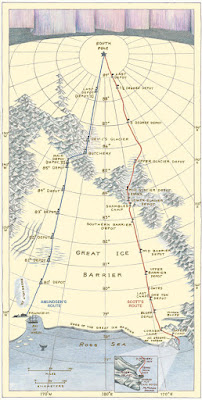 |
Amundsen’s route had never
before been taken, but it put
his starting point 60 miles
closer to the Pole than Scott’s. |
Scott patterned much of his trek after the
Nimrod expedition Ernest Shackleton had undertaken in
Nimrod and Scott’s own previous
Discovery expedition had done, and he followed the same route to the Pole Shackleton had taken. Scott carried a record of the
Nimrod expedition throughout his own march and checked his progress every evening against that of his predecessor.
1907, in which he had come within 112 miles of reaching the Pole (but had also nearly died of starvation on the way back). Scott chose to set up his base camp at McMurdo Sound, just as the
Nimrod and Scott’s own previous
Discovery expedition had done, and he followed the same route to the Pole Shackleton had taken. Scott carried a record of the
Nimrod expedition throughout his own march and checked his progress every evening against that of his predecessor.
Amundsen, on the other hand, made his base camp at the Bay of Whales, setting up his winter quarters on the edge of the Great Ice Barrier. No explorer had camped at that spot previously, for it was feared that the ice could fracture and send you floating away on a berg. But Amundsen had studied the records of past explorers who had been in the area, and saw that their descriptions of the ice had remained unchanged for decades, which Amundsen believed pointed to the area’s stability. Amundsen felt that camping there was a risk worth taking, for it positioned his starting point 60 miles closer to the Pole than Scott’s, which meant a total savings of 120 miles round trip. From the Barrier, Amundsen pioneered a route no man had trod before, and he took the straightest path possible to the Pole, traveling along a line of longitude. He had no idea what kind of terrain he’d face en route to his goal, but he was prepared to go up and over it.
As Scott trudged to the Pole, he found reason to hope that he might arrive there first, for he saw no sledge tracks or footprints along the way, and he assumed Amundsen would be using the same established path. What he did not know was that the Norwegian was on an entirely different course 500 miles to the west and already hundreds of miles ahead.
Focus on One Goal at a Time
As you may remember from our discussion on willpower, picking one goal to focus on at a time is one of the most effective ways of conserving this vital inner fuel and ensuring you have enough energy and motivation to achieve your aim. Not only that, but psychologists tell us that when you work on more than one goal, and those goals conflict with each other, your willpower gets sapped even more.
Amundsen had one goal, and one goal only: to be the first to reach the South Pole.
Scott’s expedition, on the other hand, had dual purposes: to get to the Pole first and to gather scientific information about the Antarctic. These goals were at times in conflict; to reach the Pole first, time was of the essence, while scientific work and surveying required slowing down and making careful observations. At one point during Scott’s return trip from the Pole, he and his four companions had just five days of food left, with the next depot–a pre-laid cache of food and supplies–about five days away. The margin between the men and starvation was thin, and weather conditions were ideal for making up time, but Scott decided instead to stop and take geological samples–gathering 30 stones, adding 35 pounds to the sledges, and requiring 7-8 miles of work that did not get the team any closer to the life-saving food waiting at the next depot.
Scott’s desire to advance scientific knowledge was quite noble and very earnest, and the information and samples he gathered later proved to be useful to researchers. And that is of course what makes concentrating on one goal at a time so difficult; our other goals are worthy ones too, and we want to tackle everything at once; it’s hard to feel like you’re ignoring something that should be done. But it would have been better for Scott, and for us, to check off one thing before moving on to another; Scott was already planning on going out towards the Pole again once he returned from his first trip anyway; that trip could have focused exclusively on scientific work, leaving the initial expedition to be run purely as a race.
Amundsen’s only scientific work involved making and recording daily meteorological observations at his base camp. But he didn’t do any at night, which greatly diminished the value of even this small contribution. But Amundsen understood the importance of channeling all of one’s energy into a single aim, saying:
“Our plan is one, one and again one alone–to reach the pole. For that goal, I have decided to throw everything else aside. We shall do what we can without colliding with this plan. If we were to have a night watch, we would have a light burning the whole time. In one room, as we have, this would be worrying for most of us, and make us weak. What concerns me is that we all live properly in all respects during the winter. Sleep and eat well, so that we have full strength and are in good spirits when spring arrives to fight towards the goal which we must attain at any cost.”
Work Smarter, Not Harder
One of the biggest differences between the Scott and Amundsen expeditions were the forms of transportation each man chose for their journeys.
Scott gave himself four different options for transportation: ponies, dogs, motor sledges (primitive snowmobiles), and man-hauling. The motor sledges—which hadn’t been tested in Arctic-like conditions—quickly broke down. The ponies were ill-suited to the climate and the terrain—there’s no naturally growing vegetation to feed them, they sweat through their hides, which creates sheets of ice on their bodies, and with heavy torsos and slender legs, they sink deep into the snow with every step. Thus the ponies made slow and painful process and had to all be put down.
The dogs performed gamely, but Scott did not feel they were reliable or well-suited for the crevasse-pocked terrain he would be crossing, and he sent them back to camp once he had traveled halfway to the Pole. That left three-fourths of the journey there and back to be completed through man-hauling—getting into a harness and pulling 200 pound sledges, step by step (sometimes on skis), through the snow and ice for more than 1,000 miles and a rise of 10,000 feet.
This is what Shackleton had done on his expedition, and he and other British explorers believed that man-hauling was the best—and the most noble–way to go.
But among Nordic peoples, the advantages of using dogs as much as possible was clear. The wisdom in selecting dogs was confirmed to Amundsen during one of his previous expeditions, when he had stopped to learn as much about survival in Arctic conditions as possible from those who knew the landscape most intimately: the Inuit.
Dogs were low maintenance haulers—they could be fed a variety of foods (including each other), and they kept themselves warm by digging holes to crawl inside. They also made great companions—breaking up the morale-sapping monotony of trudging through freezing wind and bleak, faceless terrain with the same four other guys for 1500 miles. And of course they were quick and fast, scampering over the snow and taking the burden of hauling off the men; Scott often marched 9-10 hours a day, while Amundsen rarely went more than 5-6, and yet in that shorter amount of time, he would sometimes cover twice the ground Scott had. Finally, because dogs can travel in colder conditions, they can run both earlier and later in the summer season than ponies, allowing Amundsen to start for the Pole two weeks before Scott—a huge advantage.
For the British, man-hauling was a source of pride, a test of manhood—they liked the purity of it, the struggle between man and nature; Scott and his men actually looked forward to turning back the dogs and getting into the harnesses for the push to the Pole. Scott wrote:
“In my mind no journey ever made with dogs can approach the height of that fine conception which is realised when a party of men go forth to face hardships, dangers, and difficulties with their own unaided efforts…Surely in this case the conquest is more nobly and splendidly won.”
I do admire something of that attitude myself. But while all struggles require some effort and grit, the most painful way, does not always equal the best way.
Successful Men Make Their Own Luck, or Failing to Prepare is Preparing to Fail
“I may say that this is the greatest factor—the way in which the expedition is equipped—the way in which every difficulty is foreseen, and precautions taken for meeting or avoiding it. Victory awaits him who has everything in order — luck, people call it. Defeat is certain for him who has neglected to take the necessary precautions in time; this is called bad luck.”
- Roald Amundsen
Preparation. This is where the rubber really hit the road for Amundsen and Scott.
It’s not that Scott didn’t prepare. He did. But he based his preparations on the conditions he had experienced on his previous Discovery expedition and on those reported during Shackleton’s Nimrod expedition. He didn’t count on Antarctica being unpredictable, and left only a thin margin for error, a small buffer against accident or inclement weather. He didn’t prepare for the worst. And yet that was what he ended up facing—freezing temperatures that only come around every couple of decades or so and powerful blizzards.
For his part, Amundsen left nothing to chance. He designed his own goggles, skis, dog harnesses, and pemmican. For the members of his team he chose men who were good with their hands, and as they waited out the winter at their base camp in preparation for the start of the expedition, Amundsen expected them to work 9-5, six days a week honing their equipment and clothing, and getting all their plans and gear shipshape.
The men made a series of tunnels and snow caves and turned them into what Amundsen called, “just one big workshop,” in which they crafted two pairs of custom skis for each man (one pair for back-up), modified the skis’ bindings to be more efficient, created better designed and lighter tents (Amundsen’s tents could be put up with one pole; Scott’s required five), lightened the sledges, and sewed their clothing and remade their boots four times until they fit perfectly and wouldn’t chafe.
All of Amundsen’s equipment was field-tested at base camp and refined again and again. Amundsen saw all this tinkering and crafting as having two invaluable benefits: 1) the gear turned out much better than those mass-produced, and 2) having had a hand in making it, the men were much more confident in how the gear would perform out on the march.
Scott’s men did refine their equipment somewhat during the winter, but spent a good deal of the time writing letters, playing sports, and attending evening lectures given by each other.
Amundsen brought the same attention to detail he had given his equipment to one of the most crucial parts of his preparation: the positioning of the depots on the way to and from the Pole. Because the men could not carry all the supplies and food they’d need for a 1500 mile journey on the sledges, depots were placed at intervals along the route before the actual expedition began. Amundsen had spent a year creating a depot-laying plan for the expedition, and still felt it had not been enough time. He laid out his depots with regularity, along each line of latitude, and packed them with ten times more food (and including 42,000 biscuits) than Scott’s. While Scott and his men died partially from starvation, Amundsen’s team actually
gained weight on their return from the Pole.
Scott hatched his depot-laying plan once he landed at McMurdo Sound and gave his men just a week to divvy up the supplies and calculate how much to stash at each depot. The depots ended up containing enough food to sustain the men, but just barely. Man-hauling has been estimated to burn 7,000 calories a day, and even up to a 11,000 when pulling uphill. Yet each man’s rations provided just 4,500 calories a day, leaving them weakened and demoralized.
And since the depots contained just a little extra fuel and food beyond what the men would need if they arrived on schedule, even if the men needed rest or could not make much progress in the weather, they had to keep pushing on to make it to the next cache of supplies; they often arrived at each depot by the skin of their teeth, with only a half day of food and fuel left.
But perhaps Scott’s greatest depot-laying mistake concerned the placement of “One Ton Depot.” During the depot-laying march before the main expedition began, the furthest depot was supposed to be laid at the 80th parallel. But the men were tired and the ponies were floundering, and Scott decided to drop the remaining supplies (2,200 lbs of them, or about one ton) right where they were, 37 miles shy of the target. This decision would prove fateful. On their return from the Pole, Scott and his hungry and exhausted men laid down to die just 12 miles from One Ton Depot. Had it been placed as originally planned, the men would have reached it, and perhaps have been saved.


